

Imagine you have an e-commerce application with multiple services:
👤 User Service
🛒 Order Service
💳 Payment Service
📦 Inventory Service
🔔 Notification Service
Should the frontend communicate directly with every service?
Usually, no.
This is where an API Gateway comes into the picture.
What is an API Gateway?
An API Gateway is a single entry point between clients and backend services.
Instead of:
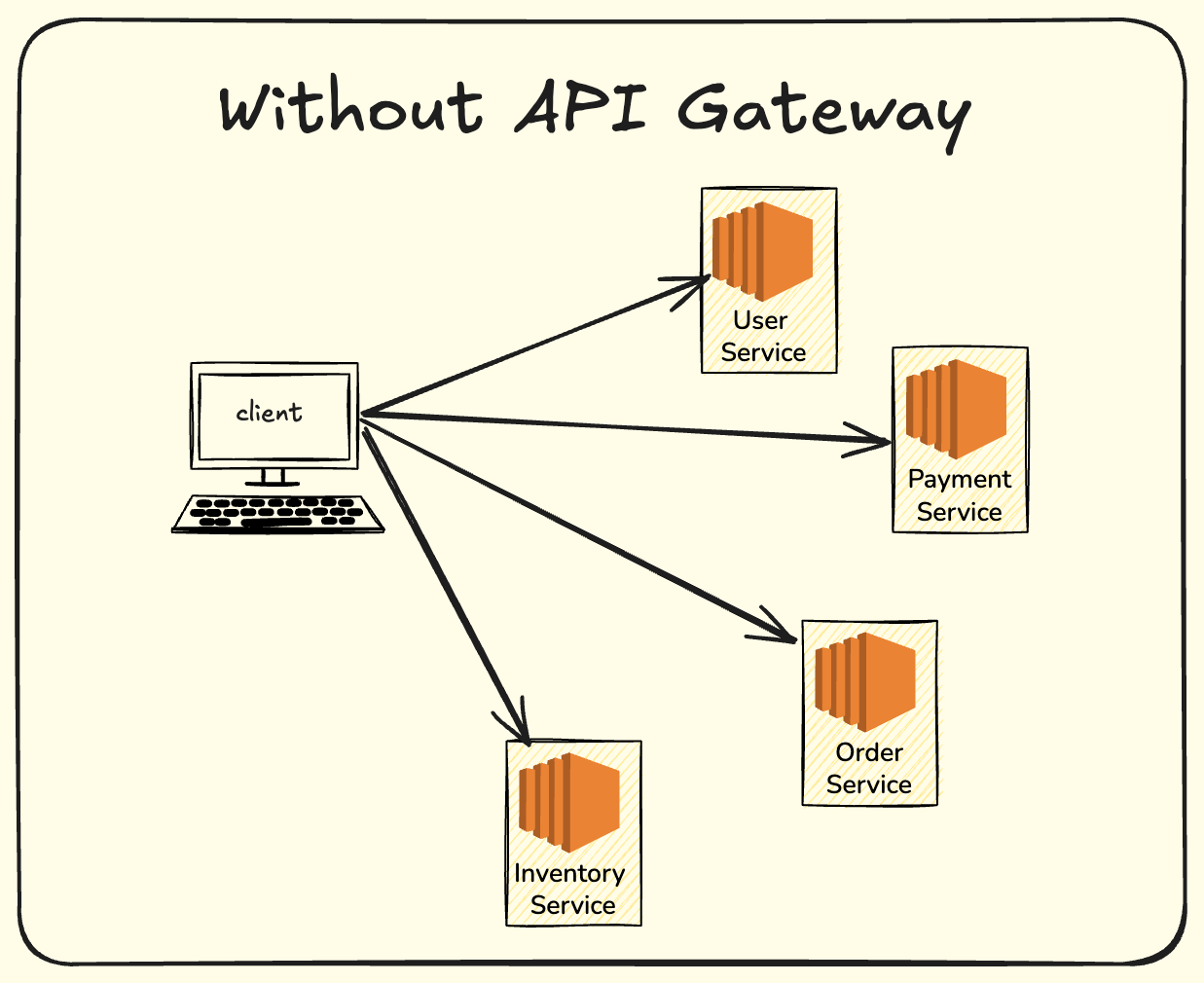
we use:
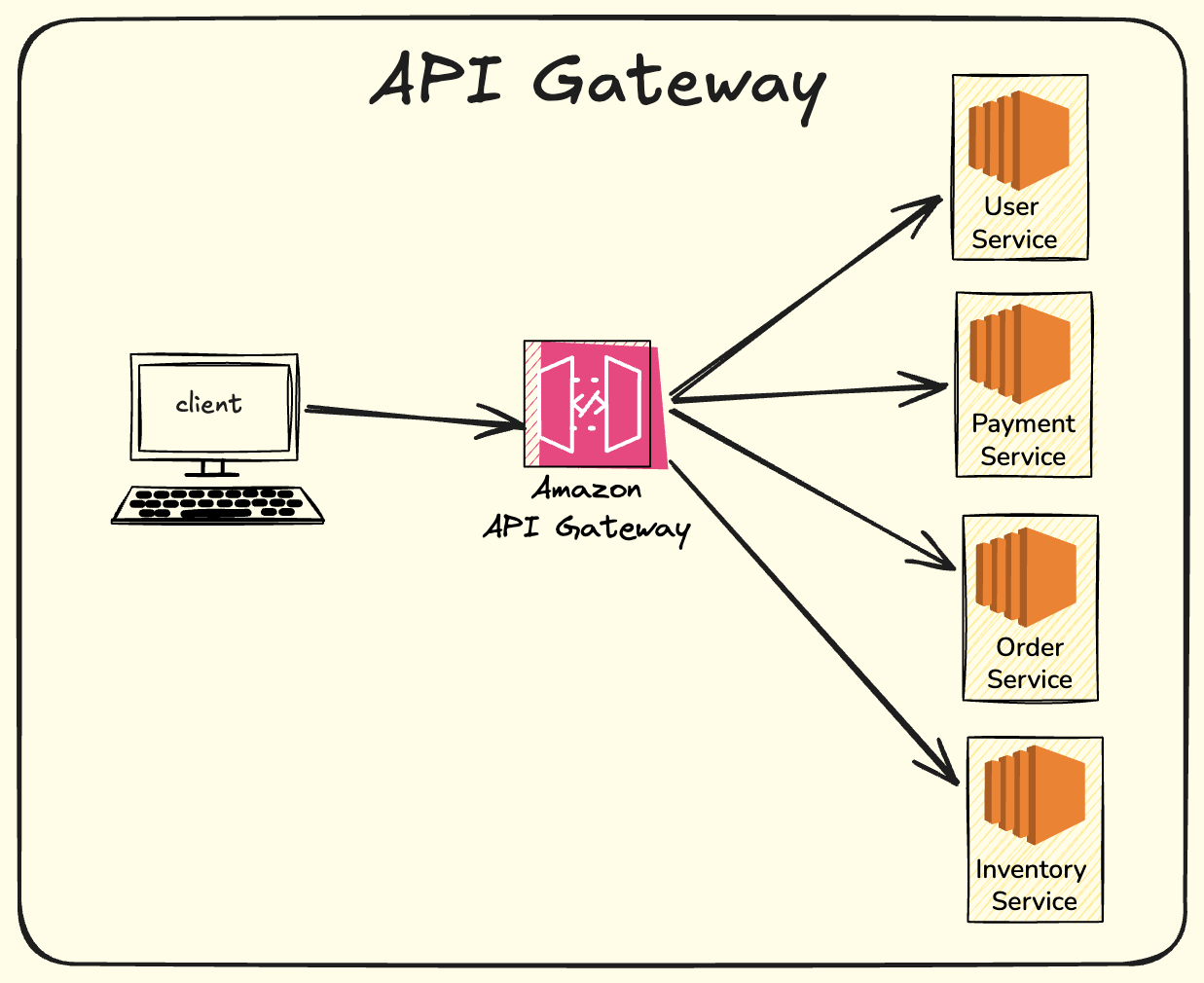
The client communicates with the gateway, and the gateway routes the request to the appropriate backend service.
Why Do We Need an API Gateway?
As your system grows, several common requirements appear:
1. Request Routing
The gateway determines where a request should go.
GET /api/users   → User Service
GET /api/orders  → Order Service
POST /api/payment → Payment Service
2. Authentication & Authorization 🔐
Instead of implementing authentication logic independently in every service, the gateway can validate:
JWT tokens
API keys
OAuth tokens
Access permissions
Client
  ↓
API Gateway
  ↓ Validate Token
  ↓
Backend Service
However, services should still enforce authorization for sensitive operations rather than blindly trusting the gateway.
3. Rate Limiting 🚦
The gateway can prevent clients from sending too many requests.
For example:
100 requests / minute / userIf the limit is exceeded:
HTTP 429 Too Many RequestsThis helps protect backend services from accidental or abusive traffic.
4. Logging & Monitoring 📊
A gateway provides a centralized place to capture:
Request/response metrics
Latency
Error rates
Request IDs
Traffic patterns
This makes troubleshooting distributed systems easier.
5. Response Aggregation
Sometimes a frontend needs data from multiple services.
Instead of making multiple requests:
Client → User Service
Client → Order Service
Client → Payment Service
the gateway can orchestrate the calls:
Client
  ↓
API Gateway
  ├──→ User Service
  ├──→ Order Service
  └──→ Payment Service
        ↓
   Combined Response
This can reduce client-side complexity and network round trips, although excessive aggregation can make the gateway harder to maintain.
🛠️ Popular API Gateway Solutions
Some commonly used options are:
Kong
NGINX
AWS API Gateway
Azure API Management
Google Cloud API Gateway
The right choice depends on your infrastructure, traffic requirements, cloud platform, and operational needs.
🆚 API Gateway vs Load Balancer
These two are often confused.
A Load Balancer primarily distributes traffic across healthy backend instances.
An API Gateway generally operates at a higher application/API layer and can provide capabilities such as authentication, rate limiting, routing, transformation, and API policies.
In many architectures, you can have both:
Client
  ↓
Load Balancer
  ↓
API Gateway
  ↓
Microservices
Or the gateway itself may incorporate load-balancing capabilities.
⚖️ The Trade-off
API Gateway provides many benefits, but it also introduces another component.
Potential challenges include:
Additional latency
Gateway becoming a bottleneck
More operational complexity
Configuration management
Failure handling
Overloading the gateway with business logic
A good API Gateway should handle cross-cutting concerns not become your entire application.
🎯 Final Thought
In a microservices architecture, the API Gateway acts as the front door to your backend.
It can simplify:
Routing + Security + Rate Limiting + Observability + Traffic Management
But the goal isn’t to put everything inside the gateway.
Keep the gateway focused on managing API traffic, while business logic remains inside the appropriate services.
That’s the key to building a scalable and maintainable API architecture.