

💉 Introduction
Imagine you’re running a restaurant.
Your chef shouldn’t have to leave the kitchen every time they need a fresh ingredient. They shouldn’t care whether the ingredient comes from Supplier A, Supplier B, or a local farmer.
They simply say:
“I need tomatoes.”
The restaurant’s supply system figures out where those tomatoes should come from.
Dependency Injection works the same way.
Instead of a class creating everything it needs by itself, you give it the dependencies it needs from the outside.
In Laravel, the Service Container takes this idea even further. It can automatically figure out which classes your application needs and resolve them for you.
This becomes especially useful when working with external API clients, payment gateways, repositories, database services, and other application services.
For example, this controller looks innocent:
class PaymentController extends Controller
{
    public function pay()
    {
        $paymentService = new StripePaymentService();
        return $paymentService->charge();
    }
}
But now the controller is tightly coupled to StripePaymentService.
Want to switch to PayPal?
You have to modify the controller.
Want to mock the payment service in a test?
You have another problem.
Want to reuse the controller with a different implementation?
Things get messy quickly.
That’s where Dependency Injection (DI) comes in.
In simple terms:
Dependency Injection means giving a class the objects it needs instead of making the class create those objects itself.
And Laravel’s Service Container does most of the heavy lifting for you.
❌ The Problem: Without DI and Tight Coupling
Let’s start with a typical Laravel payment controller.
Suppose we have this service:
namespace App\Services;
class StripePaymentService
{
    public function charge(): string
    {
        return "Payment processed through Stripe.";
    }
}
Now our controller directly creates that service:
namespace App\Http\Controllers;
use App\Services\StripePaymentService;
class PaymentController extends Controller
{
    public function pay()
    {
        $paymentService = new StripePaymentService();
        return $paymentService->charge();
    }
}
At first glance, this works perfectly.
So what’s the problem?
The controller knows too much.
It knows that:
Stripe is being used.
StripePaymentServiceis the implementation.The service must be created using
new.Stripe is the payment provider.
The controller is now tightly coupled to a concrete implementation.
👉 Problem #1: Testing Becomes Difficult
Imagine writing a PHPUnit or Pest test.
You don’t actually want to call Stripe while running your unit tests.
You want to replace the real payment service with a mock.
But the controller does this:
$paymentService = new StripePaymentService();The controller creates the dependency itself.
That makes replacing it much harder.
You can’t simply tell the controller:
"Use this mock instead."because the controller has already decided which concrete class to instantiate.
👉 Problem #2: Switching Payment Providers
Suppose your business decides to move from Stripe to PayPal.
You might end up changing:
$paymentService = new StripePaymentService();to:
$paymentService = new PayPalPaymentService();Now the controller contains payment-provider-specific logic.
And imagine having this dependency in ten different controllers.
You now have ten places to update.
That’s a maintenance problem.
👉 Problem #3: Controllers Become Responsible for Object Creation
A controller should primarily coordinate application behavior.
It shouldn’t be responsible for figuring out how every dependency should be constructed.
This:
public function pay()
{
    $paymentService = new StripePaymentService();

    return $paymentService->charge();
}
mixes two responsibilities:
Creating the dependency.
Using the dependency.
DI separates those responsibilities.
✅ The Solution: Dependency Injection
Let’s refactor the same controller.
Instead of creating StripePaymentService ourselves, we inject it through the constructor.
namespace App\Http\Controllers;
use App\Services\StripePaymentService;
class PaymentController extends Controller
{
    public function __construct(private StripePaymentService $paymentService) {}
    public function pay()
    {
        return $this->paymentService->charge();
    }
}
Notice what’s gone:
new StripePaymentService();The controller no longer creates the service.
Instead, we tell Laravel:
“This controller needs a
StripePaymentService.”
Laravel figures out how to provide it.
That’s Constructor Injection.
🎯 How Laravel Automatically Resolves Dependencies
This is where Laravel’s Service Container becomes powerful.
When Laravel needs to create:
PaymentControllerit sees:
private StripePaymentService $paymentServiceLaravel inspects the constructor and understands:
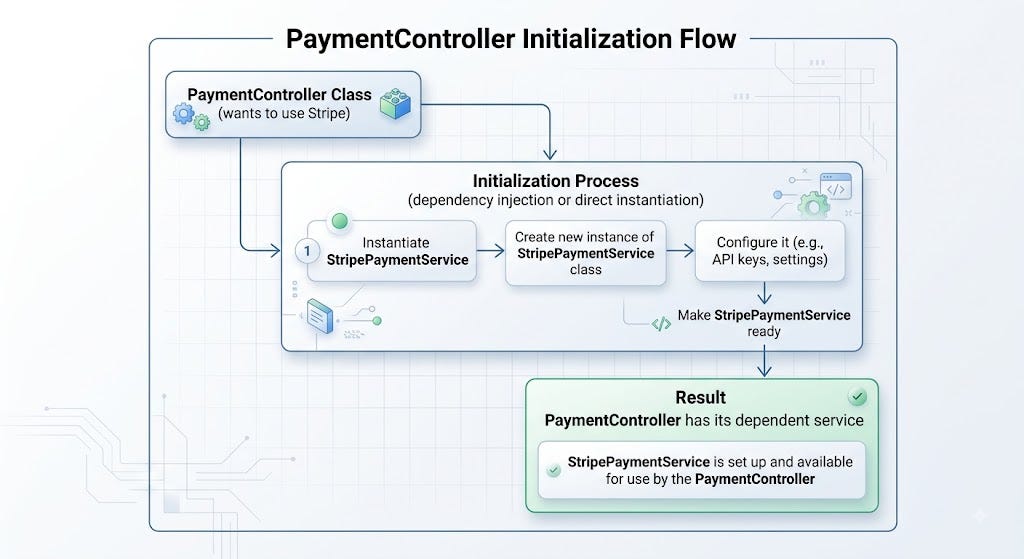
If StripePaymentService doesn’t have any complicated dependencies, Laravel can automatically instantiate it.
This is called automatic resolution or auto-wiring.
For example:
class StripePaymentService
{
    public function charge(): string
    {
        return "Payment processed through Stripe.";
    }
}
Laravel can resolve this automatically because it is a concrete class that doesn’t require any unresolved dependencies.
So you don’t need to manually write:
app()->make(StripePaymentService::class);and you don’t need:
new StripePaymentService();Laravel’s container handles it.
⚖️ Constructor Injection vs. Manual Instantiation
Without DI:
class PaymentController extends Controller
{
    public function pay()
    {
        $service = new StripePaymentService();
        return $service->charge();
    }
}
With DI:
class PaymentController extends Controller
{
    public function __construct(private StripePaymentService $service) {}
    public function pay()
    {
        return $this->service->charge();
    }
}
The second version is cleaner because the controller doesn’t care how the service is created.
It only cares that it has a service it can use.
🔌 Dependency Injection with Interfaces
Constructor injection is already useful.
But we can make our application even more flexible.
Instead of making the controller depend on:
StripePaymentServicewe can make it depend on an interface:
PaymentGatewayInterfaceThis is where DI becomes really powerful.
Let’s create the interface.
namespace App\Contracts;

interface PaymentGatewayInterface
{
    public function charge(): string;
}
Now Stripe implements that interface:
namespace App\Services;
use App\Contracts\PaymentGatewayInterface;
class StripePaymentService implements PaymentGatewayInterface
{
    public function charge(): string
    {
        return "Payment processed through Stripe.";
    }
}
Our controller no longer needs to know about Stripe.
It only knows about the contract.
namespace App\Http\Controllers;

use App\Contracts\PaymentGatewayInterface;

class PaymentController extends Controller
{
    public function __construct(
        private PaymentGatewayInterface $paymentGateway
    ) {
    }

    public function pay()
    {
        return $this->paymentGateway->charge();
    }
}
But there’s one problem.
Laravel knows how to automatically resolve concrete classes.
It doesn’t automatically know which implementation should be used for:
PaymentGatewayInterfaceThere could be several implementations.
For example:
StripePaymentService
PayPalPaymentService
RazorpayPaymentService
So we need to tell Laravel:
“Whenever someone asks for
PaymentGatewayInterface, give themStripePaymentService.”
🔧 Binding the Interface to an Implementation
The natural place for this binding is a service provider.
For example:
namespace App\Providers;
use App\Contracts\PaymentGatewayInterface;
use App\Services\StripePaymentService;
use Illuminate\Support\ServiceProvider;
class AppServiceProvider extends ServiceProvider
{
    public function register(): void
    {
        $this->app->bind(
            PaymentGatewayInterface::class,
            StripePaymentService::class,
        );
    }
}
Now Laravel has a mapping:
PaymentGatewayInterface
          ↓
StripePaymentService
Whenever Laravel sees:
PaymentGatewayInterfaceit knows to resolve:
StripePaymentServiceOur controller remains completely unaware of Stripe.
class PaymentController extends Controller
{
    public function __construct(
        private PaymentGatewayInterface $paymentGateway
    ) {
    }

    public function pay()
    {
        return $this->paymentGateway->charge();
    }
}
This is a major architectural improvement.
🔄 Switching from Stripe to PayPal
Now imagine the business decides to use PayPal.
Create another implementation:
namespace App\Services;
use App\Contracts\PaymentGatewayInterface;
class PayPalPaymentService implements PaymentGatewayInterface
{
    public function charge(): string
    {
        return "Payment processed through PayPal.";
    }
}
Then change the container binding:
$this->app->bind(
    PaymentGatewayInterface::class,
    PayPalPaymentService::class
);
That’s it.
The controller doesn’t change.
class PaymentController extends Controller
{
    public function __construct(
        private PaymentGatewayInterface $paymentGateway,
    ) {}
    public function pay()
    {
        return $this->paymentGateway->charge();
    }
}
The controller doesn’t know whether it’s using:
Stripe
PayPal
Razorpay
Adyen
MockPaymentGateway
It only knows:
PaymentGatewayInterfaceThat’s true decoupling.
🎯 Key Benefits of Dependency Injection in Laravel
1. Painless Unit Testing
One of the biggest advantages of DI is testability.
Because the dependency is injected, you can replace the real implementation with a mock.
For example, Laravel’s container can bind a mock:
$this->mock(PaymentGatewayInterface::class, function ($mock) {
    $mock->shouldReceive('charge')
        ->once()
        ->andReturn('Payment successful.');
});
Now your test doesn’t need to call a real payment provider.
You can also use Mockery directly:
$gateway = Mockery::mock(PaymentGatewayInterface::class);

$gateway->shouldReceive('charge')
    ->once()
    ->andReturn('Payment successful.');
This makes unit tests faster, deterministic, and safer.
You don’t want your PHPUnit test suite accidentally charging a real credit card.
2. True Decoupling and Flexibility
Without DI:
class PaymentController
{
    public function pay()
    {
        $service = new StripePaymentService();
    }
}
The controller depends directly on Stripe.
With DI:
class PaymentController
{
    public function __construct(
        private PaymentGatewayInterface $paymentGateway
    ) {
    }
}
The controller depends on an abstraction.
That’s the important difference.
You can change the implementation without rewriting the controller.
3. Simpler, Cleaner Controllers
A controller shouldn’t be responsible for constructing a dependency graph.
Avoid this:
public function pay()
{
    $client = new StripeClient();
    $logger = new PaymentLogger();
    $repository = new PaymentRepository();
    $service = new PaymentService(
        $client,
        $logger,
        $repository
    );

    return $service->process();
}
Instead, let Laravel resolve the dependency graph:
public function __construct(
    private PaymentService $paymentService
) {
}
Your controller becomes easier to read.
And more importantly, it becomes easier to change.
🚀 Conclusion: Let Laravel Handle the Heavy Lifting
Dependency Injection can sound like a complicated architectural concept.
In practice, the idea is simple:
Don’t make a class create the things it needs. Give it those things instead.
Laravel makes this especially powerful through its Service Container.
You can start with simple constructor injection:
public function __construct(
    private PaymentService $paymentService
) {
}
And when you need more flexibility, introduce an interface:
public function __construct(
    private PaymentGatewayInterface $paymentGateway
) {
}
Then bind the implementation:
$this->app->bind(
    PaymentGatewayInterface::class,
    StripePaymentService::class
);
Now your controllers don’t care about concrete implementations.
They care about contracts.
That’s the real value of Dependency Injection.
It gives you:
Cleaner controllers
Easier testing
Looser coupling
Swappable implementations
More maintainable architecture
And the best part?
Laravel’s Service Container handles most of the heavy lifting for you.
Excellent illustration. There are multiple ways to create software but engineer should always choose correct and best possible way to make system performant and scalable. If everyone follows correct approach then every software becomes best software.