

Batch processing is one of the most common tasks in Laravel applications. Whether you’re sending emails, generating reports, syncing data, or processing millions of records, chances are you’ve used the chunk() method.
It looks simple, performs well, and is recommended throughout the Laravel documentation.
But there’s a hidden problem.
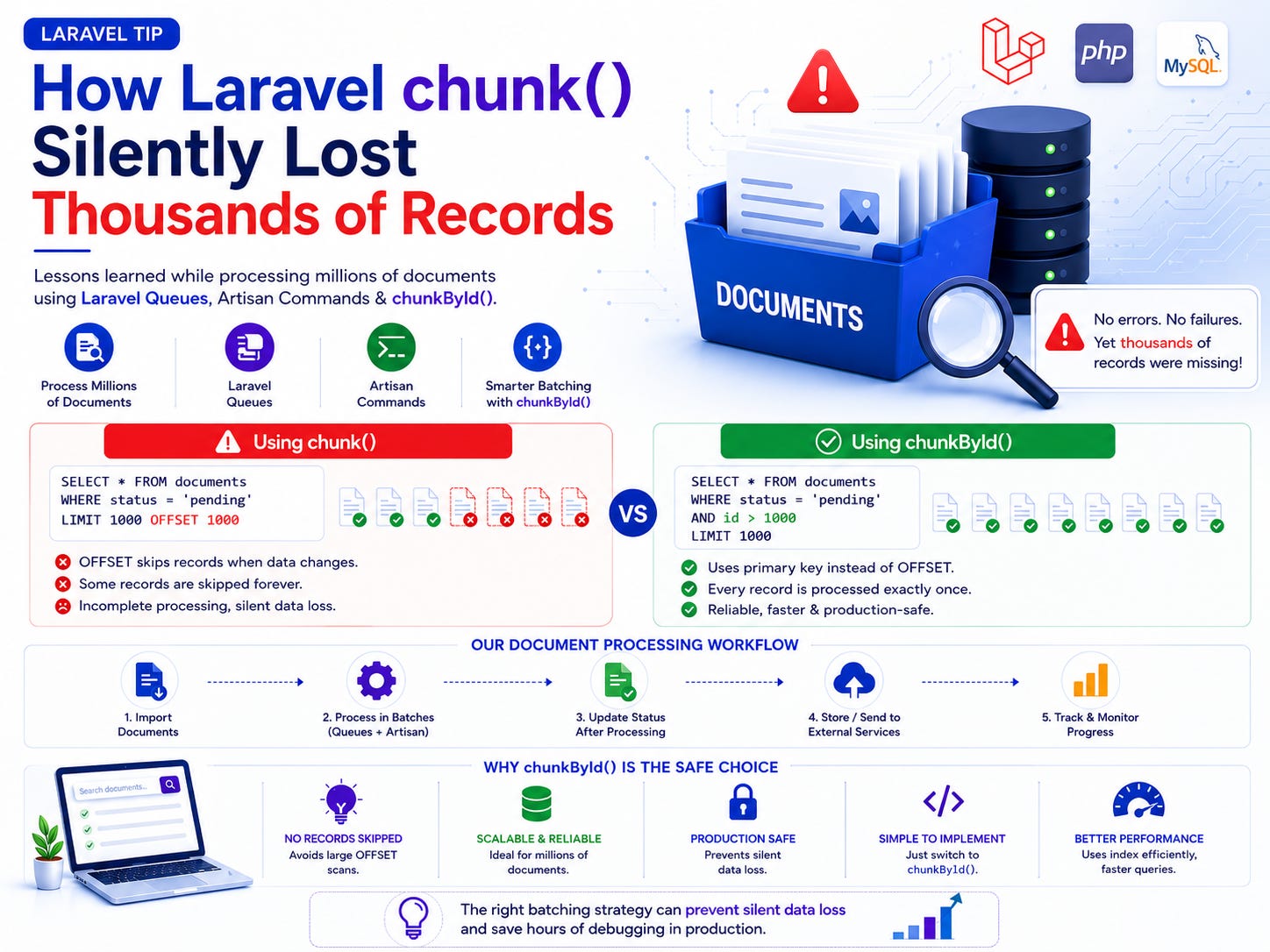
If you’re updating records while processing them, chunk() can silently skip rows, causing incomplete processing without throwing a single exception.
I first encountered this issue while working on a large-scale document import project for one of our enterprise clients. The system was responsible for importing and processing millions of documents, so we built the solution using Laravel Queues, Artisan commands, and chunk() to process the data efficiently in batches.
The implementation appeared to work perfectly during development and testing. However, in production, we discovered that some documents were never processed. There were no exceptions, no failed jobs, and no obvious signs of failure yet a portion of the data remained unprocessed.
After a detailed investigation, we traced the root cause to our use of Laravel’s chunk() method while updating the same records being processed. This experience reinforced an important lesson: choosing the right batching strategy is just as critical as writing the business logic itself, especially when working with large-scale data processing systems.
Let’s understand why this happens and how to avoid it.
📂 The Document Processing Workflow
Imagine you have a table that stores imported documents.
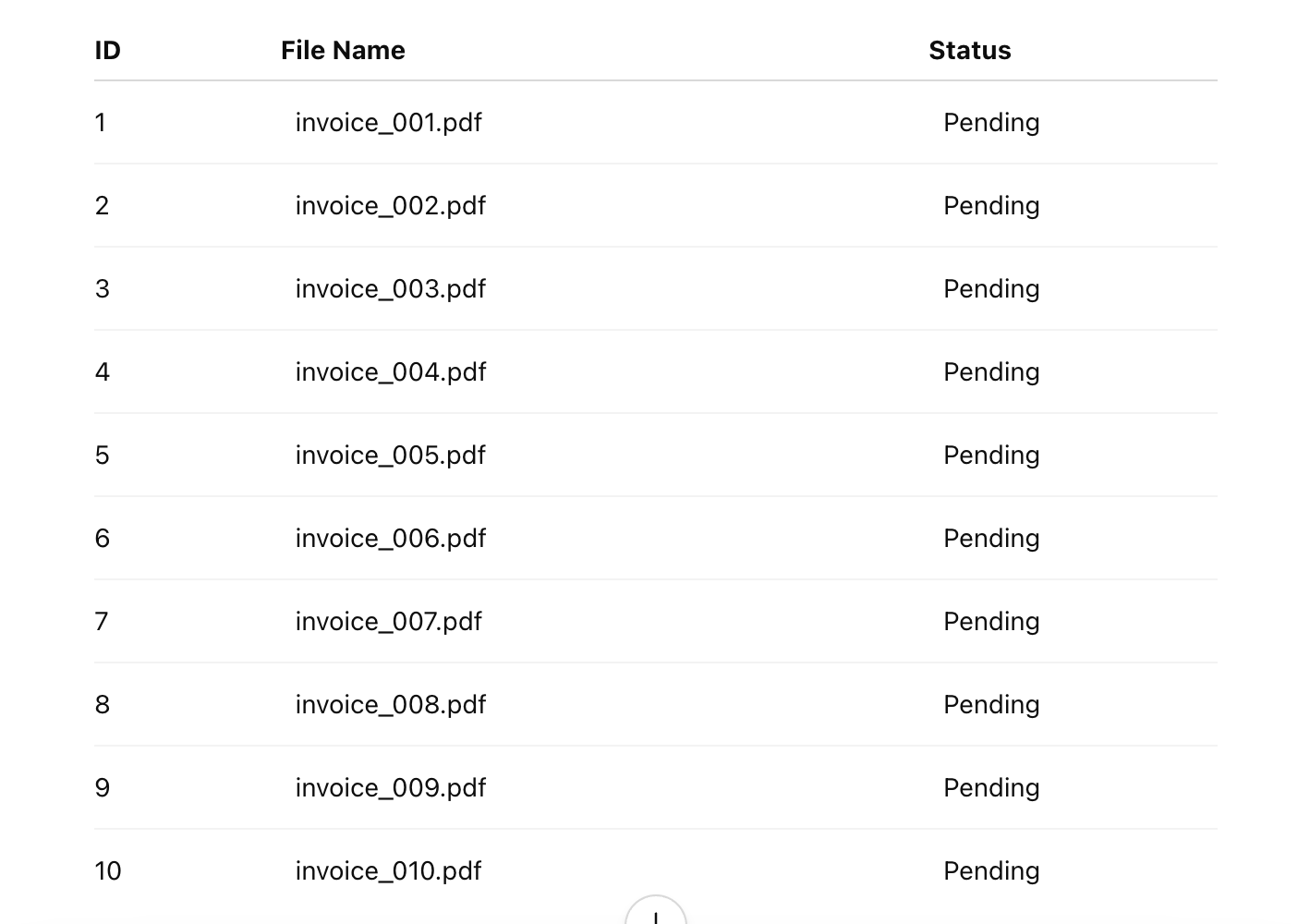
Each document goes through the following steps:
Upload it to cloud storage.
Update its status to
processed.
To avoid loading millions of records into memory, we used Laravel's chunk() method.
Document::where('status', 'pending')
    ->chunk(1000, function ($documents) {
        foreach ($documents as $document) {

            // Upload to storage

            $document->update([
                'status' => 'processed'
            ]);
        }
    });
At first glance, this looks like the perfect solution.
But there’s a hidden problem.
🗄️ What Happens Behind the Scenes?
Laravel internally executes queries similar to:
SELECT *
FROM documents
WHERE status = 'pending'
LIMIT 1000 OFFSET 0;
The first chunk returns:
1
2
3
...
1000
Each document is processed successfully.
Its status changes from:
Pendingto
ProcessedEverything still looks correct.
🔄 The Dataset Changes
After processing the first batch, those records no longer satisfy:
WHERE status = 'pending'The pending dataset now starts from the next unprocessed documents.
For simplicity, imagine our table contains only ten documents.
The remaining pending documents are now:
4
5
6
7
8
9
10
Notice that documents 1, 2, and 3 have disappeared from the result because their status changed.
⚠️ Here’s Where the Problem Begins
Laravel now executes the next query using OFFSET.
LIMIT 3 OFFSET 3The current pending dataset is:
Index    Document ID

0  ---> 4
1  ---> 5
2  ---> 6
3  ---> 7
4  ---> 8
5  ---> 9
6  ---> 10
OFFSET skips the first three rows.
❌ 4
❌ 5
❌ 6
Laravel processes only:
✅ 7
✅ 8
✅ 9
Documents 4, 5, and 6 are never processed.
Document 10 also remains pending because no further chunk includes it in this small example.
The Artisan command completes successfully.
The queue reports success.
No exception is thrown.
But several documents remain unprocessed.
📊 Visualizing the Problem
Initial Pending Documents

1 2 3 4 5 6 7 8 9 10

        │
        ▼

Process First Chunk

[1 2 3]

        │
        ▼

Update Status = Processed

Remaining Pending

4 5 6 7 8 9 10

        │
        ▼

Laravel Executes

OFFSET 3

        │
        ▼

❌ Skip

4 5 6

        │
        ▼

Process Next Chunk

7 8 9
This is exactly why some documents never get processed.
🤔 Why Does This Happen?
The issue isn’t with Laravel.
It’s with OFFSET-based pagination.
When your code updates the same records that your query depends on, the result set changes after every batch.
However, OFFSET continues counting based on the old position.
As a result, some rows are skipped entirely.
✅ The Correct Solution: chunkById()
Instead of relying on OFFSET, Laravel provides chunkById().
Document::where('status', 'pending')
    ->chunkById(1000, function ($documents) {

        foreach ($documents as $document) {

            // Process document

            $document->update([
                'status' => 'processed'
            ]);

        }

    });
Rather than using OFFSET, Laravel keeps track of the last processed primary key.
The queries become:
WHERE id > 0
LIMIT 1000

↓

WHERE id > 1000
LIMIT 1000

↓

WHERE id > 2000
LIMIT 1000
Since primary keys don’t change when the status is updated, every document is processed exactly once.
No skipped records.
No incomplete imports.
⚡ An Additional Performance Benefit
chunkById() isn’t just safer it also performs better on large datasets.
With chunk(), MySQL must scan and discard rows to satisfy large OFFSET values.
For example:
LIMIT 1000 OFFSET 500000The database still has to read the first 500,000 rows before returning the next 1,000.
With chunkById():
WHERE id > 500000
LIMIT 1000
MySQL can efficiently use the primary key index, making queries much faster for millions of records.
📝 Best Practices
When building document processing pipelines:
✅ Use
chunk()only for read-only operations.✅ Use
chunkById()if you’re updating or deleting records.✅ Keep processing jobs idempotent so they can be retried safely.
✅ Test batch-processing logic with production-sized datasets.
✅ Monitor processed vs. pending record counts after every batch.
🎯 Key Takeaways
🚫
chunk()uses OFFSET pagination.🚫 Updating the records being processed changes the result set.
🚫 OFFSET can silently skip records.
✅
chunkById()navigates using the primary key instead of OFFSET.✅ Every document is processed exactly once.
✅ It also scales better for millions of records.
🎉 Final Thoughts
This wasn’t a Laravel bug it was a subtle behavior of OFFSET-based pagination that surfaced in a real production workload.
Because the job completed successfully, the issue was difficult to detect. We only discovered it after reconciling the number of imported documents against the number of processed documents.
That experience taught our team an important lesson:
Whenever your batch job modifies the same records it is reading,
chunkById()should be your default choice.
It’s a small change in code, but it can prevent missing records, incomplete imports, and long hours of production debugging especially when processing millions of documents.
Thank you Pritesh for sharing such insightful thoughts.