

“In software, as in life, the most powerful systems are those that work quietly in the background.” As Laravel developers, we often focus on building elegant controllers, expressive routes, and beautifully designed frontends. But behind every elegant system lies invisible intelligence — logic that responds to events without being manually triggered every time. In Laravel, this invisible layer is brought to life by Observers.
🧠 What Is a Laravel Observer?
A Laravel Observer is a dedicated class that listens for model events such as:
creating,createdupdating,updatedsaving,saveddeleting,deletedrestoring,restored
Think of it like a watcher assigned to a specific Eloquent model. When something happens to that model — a record is created, updated, or deleted — the observer steps in to run predefined logic.
🚀 Why Use Observers?
Without Observers:
You write the same logic (e.g., logging or notifications) in multiple controllers or services. Your code becomes scattered and hard to maintain.
With Observers:
You encapsulate all that logic in one dedicated class that responds automatically to changes — like a rulebook attached to a model’s life.
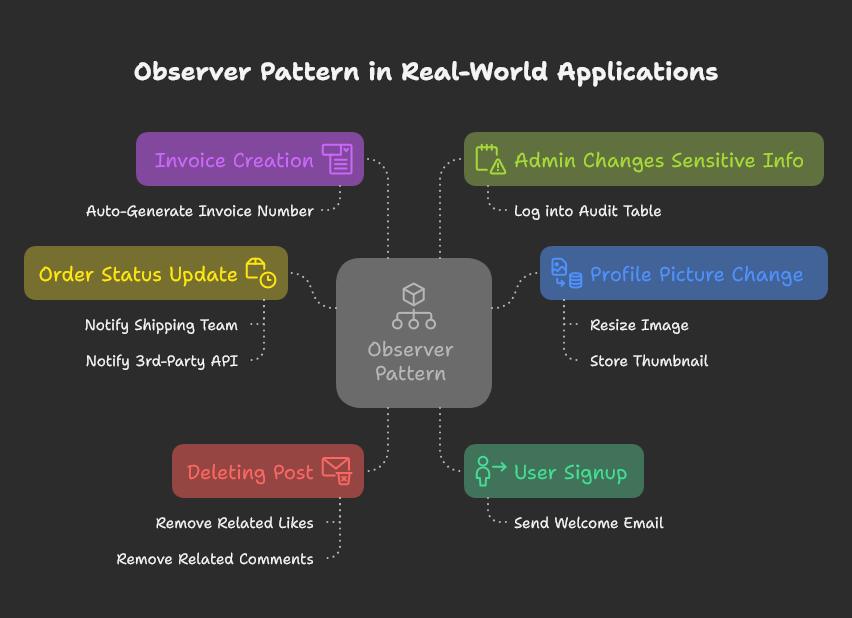
🔍 Real-World Examples:
Send a welcome email when a user is created
Log updates to sensitive user data
Track when a record is soft deleted for audit
Create a record in a secondary table on update
Sync external APIs on creation
🔧 How to Implement an Observer
Let’s say we have a model User. Every time a new user is created, we want to:
Send a welcome email.
Log the registration in an activity log table.
🛠 Step 1: Create the Observer
php artisan make:observer UserObserver --model=UserThis generates app/Observers/UserObserver.php.
🛠 Step 2: Define Observer Methods
namespace App\Observers;

use App\Models\User;
use App\Jobs\SendWelcomeEmail;
use Illuminate\Support\Facades\Log;

class UserObserver
{
    public function created(User $user)
    {
        // Send welcome email
        SendWelcomeEmail::dispatch($user);

        // Log the creation
        Log::info("New user registered: " . $user->email);
    }

    public function updated(User $user)
    {
        Log::info("User updated: " . $user->email);
    }

    public function deleted(User $user)
    {
        Log::warning("User deleted: " . $user->email);
    }
}
🛠 Step 3: Register the Observer
In App\Providers\EventServiceProvider.php
use App\Models\User;
use App\Observers\UserObserver;

public function boot(): void
{
    User::observe(UserObserver::class);
}
⚠️ Gotchas: When Observers Are Not Triggered
While observers are powerful, they do not trigger in every case. Here are some common situations where they remain silent:
❌ 1. Using insert() Instead of create()
$data = [
    ['name' => 'Alice', 'email' => 'alice@example.com'],
    ['name' => 'Bob', 'email' => 'bob@example.com'],
];

User::insert($data); // ❌ Observer won't trigger
insert() performs a bulk insert without creating Eloquent models — so no creating or created events are fired.
❌ 2. Using Query Builder or Raw SQL
DB::table('persons')->update(['email' => 'test@example.com']); // ❌ No eventsOnly Eloquent model operations like create(), update(), save(), delete() trigger observers.
💼 When Should You Use Observers?
Use Observers When:
✅ You want to centralize repetitive logic (e.g., audit logging, notifications)
✅ You want to enforce lifecycle behavior for a model
✅ You need to act automatically on model changes across the system
Avoid Observers When:
❌ You’re doing heavy bulk operations
❌ You want to manually control side-effects
❌ Your logic is complex and tightly coupled to other models (prefer services instead)
🌐 Real-World Use Cases
🪶 Final Thoughts
When used well, Laravel Observers help you write elegant, scalable code while embracing the age-old wisdom:
“Do not chase every moment. Instead, build systems that respond when the moment comes.”
They are your trusted watchmen — always present, always ready. Give them the right tasks, and they will repay you with stability, clarity, and peace of mind.
In the end, Observers remind us that precision doesn’t have to be noisy. The quietest parts of a system often carry the heaviest responsibilities.
So the next time you build a Laravel model, ask yourself:
What silent responsibilities can I hand over to an Observer?