

💡 Introduction: Why ACID Matters
Every modern web application from eCommerce platforms to financial systems relies on data integrity.
When users transfer money, create orders, or update profiles, they expect one thing: the data should be accurate, consistent, and safe, no matter what happens in the backend.
This is where ACID properties come in.
In relational databases like MySQL, ACID ensures that each database transaction behaves predictably, even in the face of power failures, concurrency issues, or application crashes.
Laravel, with its expressive Eloquent ORM and database abstractions, gives developers easy access to these principles without needing to write low-level SQL.
⚙️ What Does ACID Stand For?
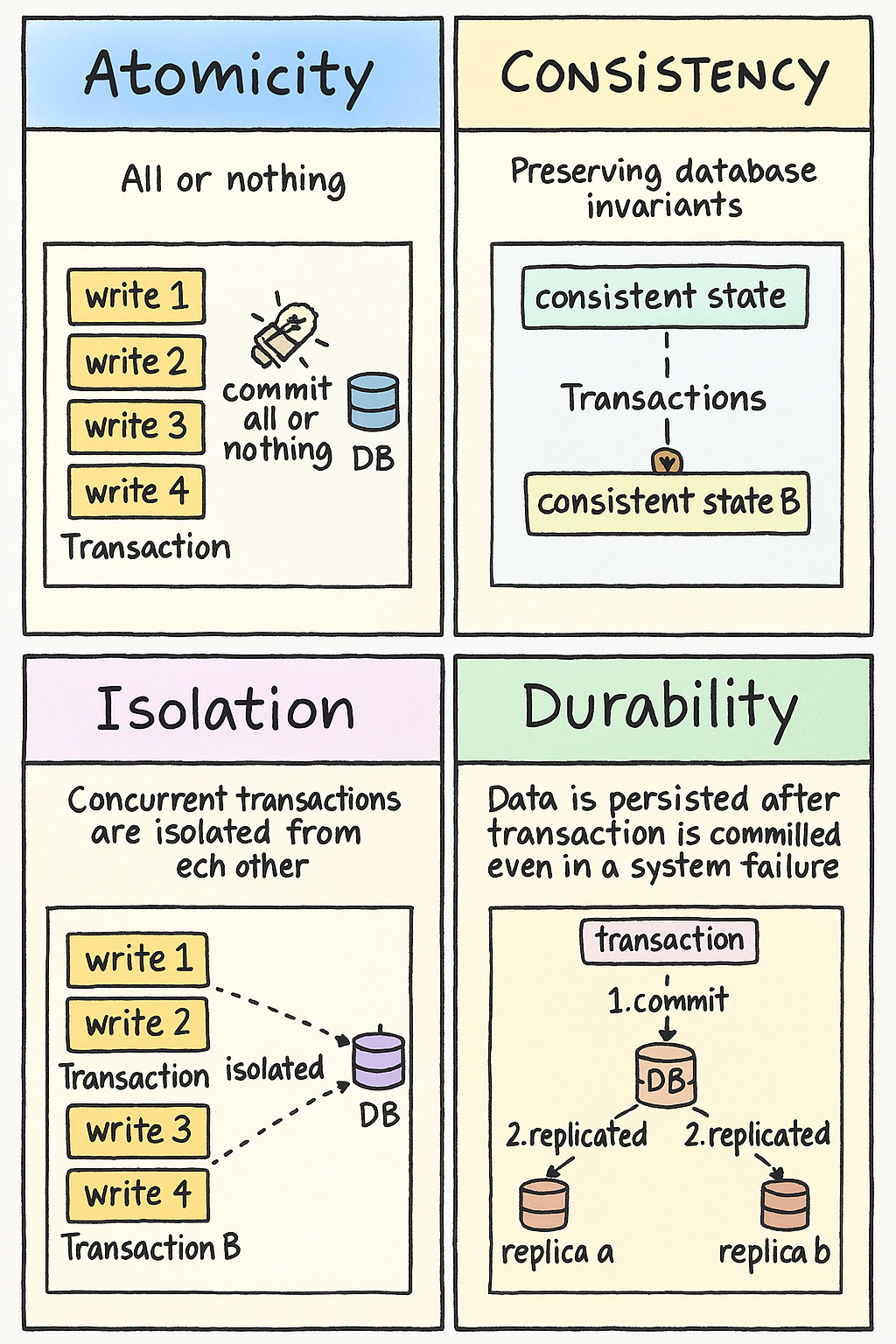
ACID is an acronym for four key properties that define reliable database transactions:
A — Atomicity A transaction is all or nothing. Either all operations succeed, or none do.
C — Consistency The database must remain in a valid state before and after a transaction.
I — Isolation Concurrent transactions should not interfere with each other. D — Durability Once committed, data remains safe even after failures.
Let’s explore each property in detail with Laravel and MySQL examples.
🔹 1. Atomicity — All or Nothing
Atomicity ensures that either all steps of a transaction succeed or none do.
💬 Example: Transferring Money Between Accounts
Imagine a banking system where we transfer ₹100 from Account A to Account B.
We must decrease the balance of A and increase the balance of B in a single atomic transaction.
If the system crashes after debiting A but before crediting B — the transaction must roll back.
✅ Laravel Example
use Illuminate\Support\Facades\DB;

try {
    DB::beginTransaction();

    // Debit from Account A
    DB::table(’accounts’)->where(’id’, 1)->decrement(’balance’, 100);

    // Credit to Account B
    DB::table(’accounts’)->where(’id’, 2)->increment(’balance’, 100);

    DB::commit();
} catch (\Exception $e) {
    DB::rollBack();
    Log::error(’Transaction failed: ‘ . $e->getMessage());
}
Or more elegantly:
DB::transaction(function () {
    DB::table(’accounts’)->where(’id’, 1)->decrement(’balance’, 100);
    DB::table(’accounts’)->where(’id’, 2)->increment(’balance’, 100);
});
💡 Best Practice:
Use DB::transaction() whenever you perform multiple related writes that must succeed or fail together.
🔹 2. Consistency — Maintaining Data Integrity
Consistency ensures that the database transitions from one valid state to another.
This is often maintained using constraints, foreign keys, validation, and business logic.
💬 Example: Creating an Order and Order Items
If you create an order but fail to insert the related order items, your database becomes inconsistent.
✅ Laravel Example
DB::transaction(function () {
    $order = Order::create([
        ‘user_id’ => 1,
        ‘total’ => 500,
    ]);

    OrderItem::create([
        ‘order_id’ => $order->id,
        ‘product_id’ => 42,
        ‘quantity’ => 2,
        ‘price’ => 250,
    ]);
});
💡 Database-Level Consistency
At the schema level, we ensure consistency with foreign key constraints and unique indexes:
Schema::create(’order_items’, function (Blueprint $table) {
    $table->id();
    $table->foreignId(’order_id’)->constrained()->onDelete(’cascade’);
    $table->foreignId(’product_id’)->constrained();
    $table->integer(’quantity’);
    $table->decimal(’price’, 10, 2);
});
If someone tries to insert an order item with an invalid order_id, MySQL will reject it maintaining consistency.
🔹 3. Isolation — Safe Concurrent Transactions
Isolation means that concurrent transactions don’t affect each other’s results.
MySQL supports multiple isolation levels:
READ UNCOMMITTED Can read uncommitted data (dirty reads).
READ COMMITTED Reads only committed data.
REPEATABLE READ (default in MySQL) Same result for repeated reads within a transaction.
SERIALIZABLE Highest isolation; transactions run one after another.
💬 Example: Preventing Double Spending
Two users try to withdraw from the same account simultaneously.
Isolation ensures that one transaction waits until the other completes.
✅ Laravel Example
DB::transaction(function () {
    $account = DB::table(’accounts’)
        ->where(’id’, 1)
        ->lockForUpdate()
        ->first();

    if ($account->balance >= 100) {
        DB::table(’accounts’)->where(’id’, 1)->decrement(’balance’, 100);
    } else {
        throw new \Exception(’Insufficient balance.’);
    }
});
lockForUpdate() prevents other transactions from reading or updating the same row until this one finishes ensuring isolation.
🔹 4. Durability — Data That Stays
Durability ensures that once a transaction is committed, it will remain saved even if a power failure or crash occurs.
In MySQL’s InnoDB engine, durability is maintained using:
Redo logs (write-ahead logs)
Automatic crash recovery
fsync() writes to disk after commit
💬 Laravel’s Role
Laravel delegates durability to MySQL — but you can ensure safer commits by:
Using
DB::transaction()to avoid half-committed writesConfiguring InnoDB as the storage engine
Setting proper
innodb_flush_log_at_trx_commit(default1ensures maximum durability)
🧩 Putting It All Together: A Real-World Scenario
Scenario: Order Creation with Payment Logging
DB::transaction(function () use ($request) {
    $order = Order::create([
        ‘user_id’ => $request->user_id,
        ‘total’ => $request->total,
    ]);

    foreach ($request->items as $item) {
        OrderItem::create([
            ‘order_id’ => $order->id,
            ‘product_id’ => $item[’product_id’],
            ‘quantity’ => $item[’qty’],
            ‘price’ => $item[’price’],
        ]);
    }

    Payment::create([
        ‘order_id’ => $order->id,
        ‘amount’ => $order->total,
        ‘status’ => ‘SUCCESS’,
    ]);
});
If any insert fails, Laravel automatically rolls back ensuring Atomicity, Consistency, and Durability.
MySQL’s transaction isolation ensures that other users see consistent data while this operation is in progress.
🧭 Best Practices for Handling Transactions in Laravel
✅ Use
DB::transaction()for multi-step operations.🔁 Handle Exceptions Gracefully - rollback on failure and log errors.
🧱 Leverage Database Constraints (foreign keys, unique keys).
⚙️ Tune Isolation Levels - use
REPEATABLE READfor safety, orREAD COMMITTEDfor performance.🧩 Keep Transactions Short - long-running transactions can cause locks and deadlocks.
💾 Always Use InnoDB - for full ACID compliance.
🧾 Summary & Key Takeaways
Atomicity ensures operations succeed together.
Consistency keeps your data valid and rules enforced.
Isolation prevents race conditions in concurrent access.
Durability guarantees data safety after commits.
When combined, these principles make your Laravel + MySQL applications reliable, predictable, and production-safe.
Building with ACID in mind means your users can trust your app - every time they hit “Submit”.